
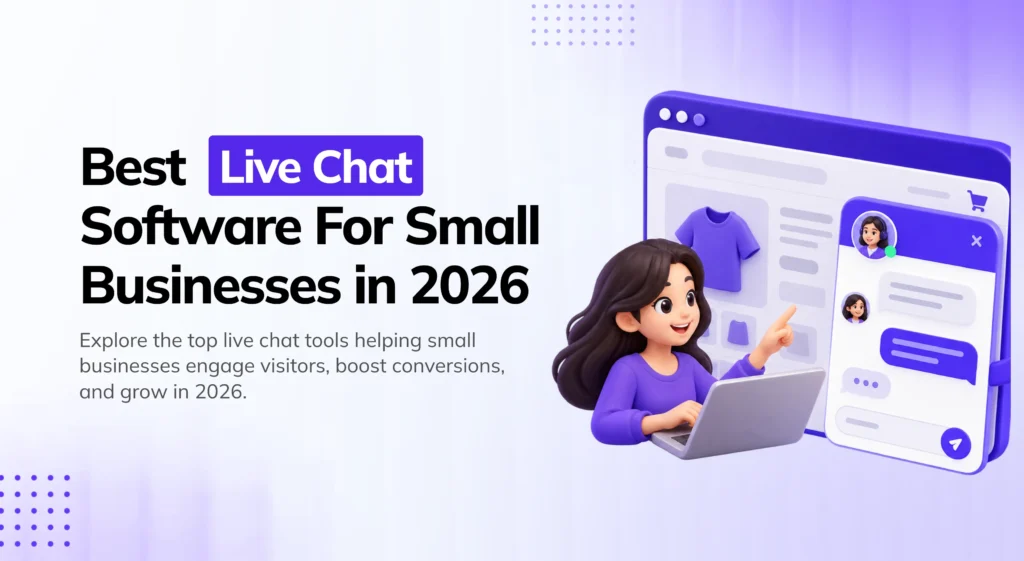
A small business doesn’t need the same live chat platform as a 500-person enterprise support team — and pricing pages will happily let you find out the hard way.
For a small business, live chat isn’t one job. It’s a sales tool when a visitor has a pre-purchase question, a support channel when something’s gone wrong, and sometimes the only real-time way a customer can reach you at all. That means the right live chat software for small business isn’t the platform with the longest feature list — it’s the one that fits your team size, your budget, and the way your customers actually reach out.
The live chat market in 2026 has split into a few clear camps: AI-first conversational platforms chasing automation, sales-focused chat tools built for e-commerce, and flat-rate or seat-based options aimed squarely at smaller teams. Pricing models vary just as much — some charge per agent seat, some charge per conversation, and some (like YS Desk) keep it simple with a seat-based plan that scales predictably as you grow.
In this guide, we’ll walk through the best live chat software for small businesses in 2026, starting with our top overall pick, and compare each option on price, features, and who it’s actually built for.
How We Compared These Tools
Rather than ranking by feature-list length, we evaluated each platform against what actually matters to a small business:
- Real-world pricing — not just the headline number, but what a team of 3–5 people would actually pay once seats, conversation limits, or AI add-ons are factored in.
- Ease of setup — how quickly a non-technical small business owner can get a working chat widget live on their site.
- Core chat functionality — real-time messaging, file sharing, canned responses, and mobile responsiveness.
- Visitor and conversation insight — whether the platform shows you who’s on your site right now, not just who’s already messaged you.
- Room to grow — whether the pricing model punishes you the moment your team or conversation volume grows, or scales with you predictably.
1. YS Desk — Best Overall Live Chat Software for Small Business
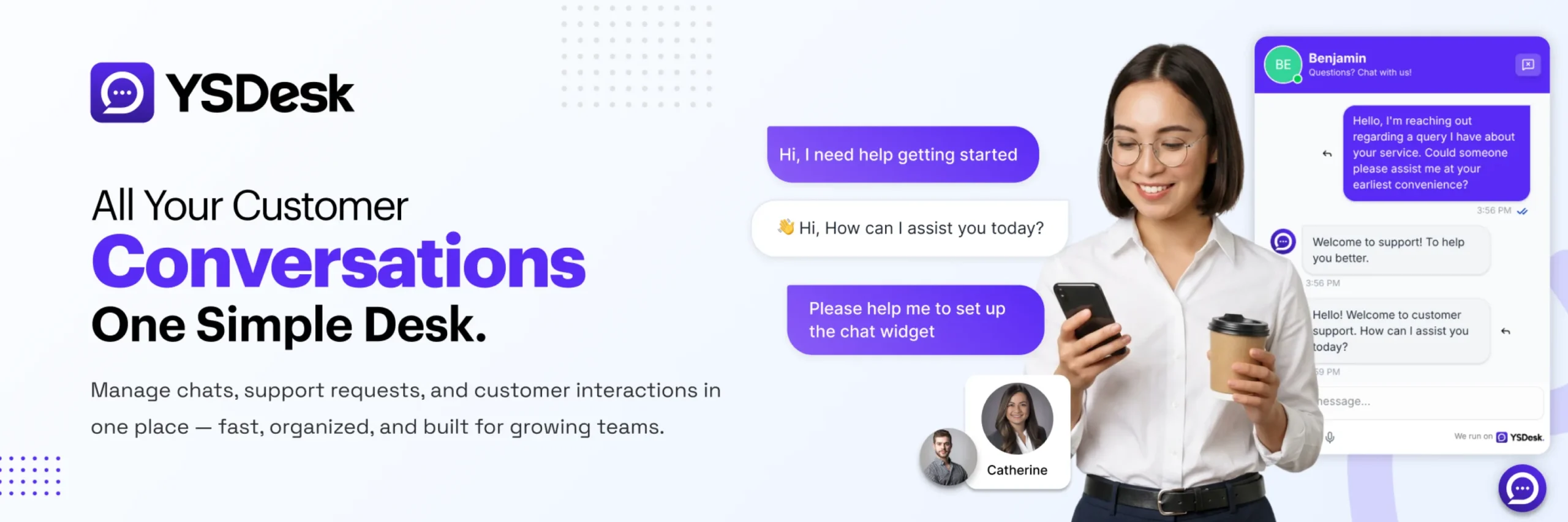
YS Desk takes the top spot for small businesses in 2026 because it doesn’t force a trade-off between price and capability — something several competitors on this list genuinely do.
The free plan includes one agent seat and 100 conversations a month, which is enough for a solo operator or a very early-stage business to run real support and sales chat without paying anything. From there, YS Desk scales through clearly published, seat-based pricing — $12/month for the Starter plan (3 seats, 500 conversations), $39/month for Growth (10 seats, 2,000 conversations), and custom Enterprise pricing beyond that. There’s no separate AI add-on tax, no conversation-based overage cliff, and no confusing jump between tiers.
What makes it stand out for small teams specifically:
- Real-time messaging that’s actually real-time. YS Desk runs on WebSocket-based infrastructure, so message delivery, conversation status, agent presence, and unread counts all sync live — not on a delayed refresh cycle.
- Live visitor monitoring on every plan. You can see who’s actively browsing your site right now, not just who’s already started a conversation, which most competitors reserve for higher tiers or omit entirely.
- A genuinely embeddable, customizable widget. Branding color, gradient, launcher position, animation style, and even a typewriter effect on the launcher label are all configurable — the widget can actually look like part of your site rather than a bolted-on tool.
- Built-in CSAT starting on the Starter plan. 1–5 star guest ratings, optional comments, and a public rating page are included from $12/month, where several competitors gate satisfaction surveys behind a mid-tier plan.
- Conversation assignment and internal notes from day one. Even small teams benefit from being able to assign a conversation to a specific person and leave internal notes without the customer seeing them — features that some entry-level competitors don’t unlock until a higher tier.
- Canned responses with shortcuts and categories. Up to 10 canned responses on the free plan, 50 on Starter, and unlimited from Growth onward — with slash-command shortcuts (/) for fast access mid-conversation.
- Transparent, predictable pricing. No per-conversation billing that can spike unexpectedly during a busy month, and no separate AI or automation add-on priced outside the plan.
Where it’s not the right fit: if you specifically need a heavy chatbot-automation layer (multi-step bot flows, AI-driven lead qualification) as your primary feature, YS Desk’s roadmap is still growing in that direction — Tidio or Intercom are more mature there today.
Pricing: Free (1 seat, 100 conversations/mo) · Starter $12/mo (3 seats, 500 conversations/mo) · Growth $39/mo (10 seats, 2,000 conversations/mo) · Enterprise: custom (50+ seats, unlimited conversations).
Best for: small businesses and growing teams that want a real free tier, honest pricing as they scale, and live chat that’s genuinely built for both sales and support — not just support with a chat widget bolted on.
2. Tidio — Best for Chatbot Automation
Tidio combines live chat with a visual chatbot builder and its Lyro AI assistant, and it’s a strong pick specifically for e-commerce stores that want automation handling a meaningful share of conversations before a human ever gets involved.
The free plan supports up to 10 seats and 50 conversations a month, and Starter moves to $29/month (or roughly $24/month billed annually) for 100 conversations. Growth runs from $59/month for up to 2,000 conversations. Where it gets more complicated is the AI layer: Lyro is priced and billed separately from the base plan, and removing the “Powered by Tidio” badge isn’t included until the Plus tier. There’s also a well-documented pricing cliff — Growth tops out at $59/month, and the next published tier, Plus, jumps to $749/month with nothing in between.
Pricing: Free (up to 10 seats, 50 conversations/mo) · Starter ~$24–29/mo (100 conversations/mo) · Growth from $59/mo (up to 2,000 conversations/mo) · Plus from $749/mo.
Best for: e-commerce businesses that want chatbot automation as a first-class feature and are comfortable managing a slightly more complex, usage-based pricing structure.
3. Crisp — Best Flat-Rate Pricing for Small Teams
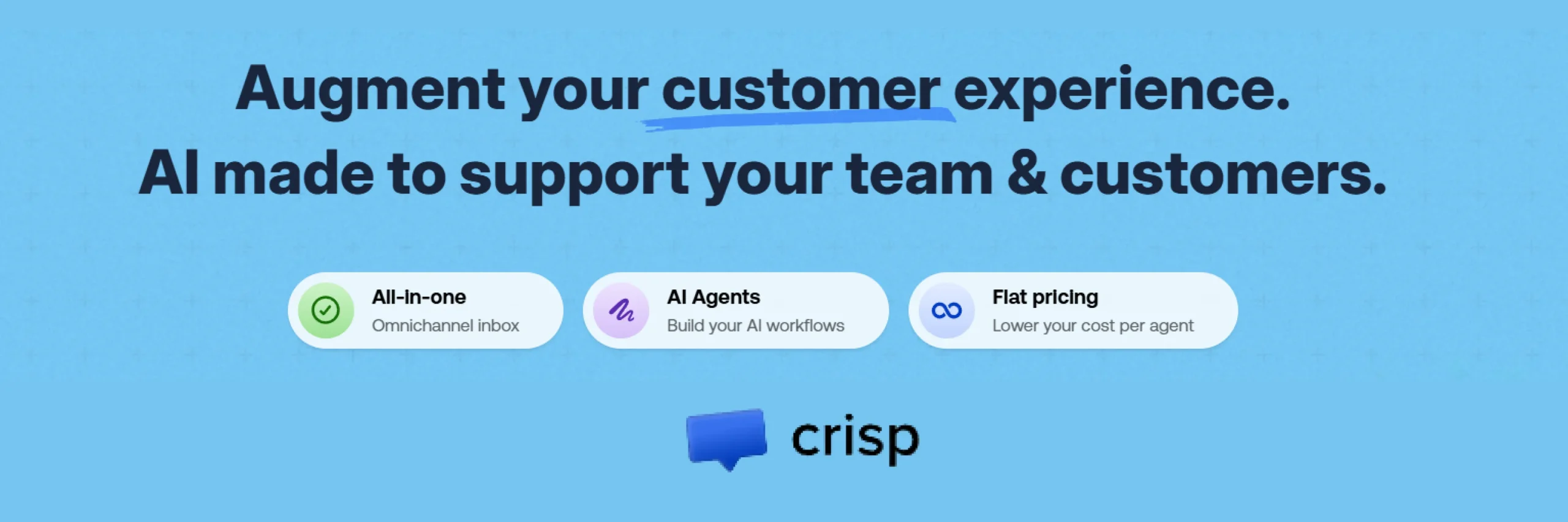
Crisp takes a different approach from most of this list: instead of charging per agent seat, it charges per workspace. The Pro plan includes 4 agents for $25/month, and the Unlimited plan includes unlimited agents for $95/month — which makes Crisp the clear winner on pure cost-per-agent for any team of five or more, since a 10-person team on Crisp Unlimited pays a flat $95/month versus $240–390/month on seat-based competitors covering the same headcount.
Crisp bundles live chat with a shared inbox and multi-channel messaging (email, and depending on plan, social channels), which makes it a genuinely all-in-one option for small teams that don’t want to manage separate tools for each channel.
Pricing: Free (limited) · Pro $25/mo (4 seats) · Unlimited $95/mo (unlimited seats).
Best for: small teams of three or more who’d rather pay one flat fee than do per-seat math every time they hire, and who want messaging channels beyond just the website widget.
4. LiveChat — Best for Dedicated Sales/Support Chat
LiveChat has been around long enough to be a genuinely mature, polished product, and it shows in the day-to-day agent experience — the interface is clean, reliable, and has one of the shortest learning curves of any platform on this list for agents who are just answering chats, not building automation.
Pricing is per-agent, and it runs noticeably higher than YS Desk or Crisp: Starter is $25/month per agent, Team is $59/month per agent, and Business is $89/month per agent (annual billing is somewhat lower). For a five-person team, that puts LiveChat’s realistic monthly cost well above $250–400/month even on a mid-tier plan — a real consideration for a small business comparing total cost, not just the entry price.
Pricing: Starter $25/agent/mo · Team $59/agent/mo · Business $89/agent/mo (billed monthly; annual billing is lower).
Best for: small businesses with a dedicated, staffed chat team who value a mature, reliable agent workspace and can absorb higher per-seat costs as the team grows.
5. Intercom — Best for Scaling SaaS Teams

Intercom is one of the most capable platforms on this list, particularly for SaaS businesses that want messaging, in-app product tours, and AI-assisted resolution (Fin AI) in one system. But it’s also consistently flagged across independent comparisons as the platform most likely to cost more than a small business expects, since pricing combines a per-seat base with usage-based add-ons for AI resolutions.
Entry pricing starts around $29–39 per seat per month, and the real monthly bill for a small team is frequently higher once AI features are added — this is less a criticism of Intercom’s capability and more a note that it’s genuinely built with larger, better-resourced teams in mind.
Pricing: From ~$29–39/seat/mo, with AI resolution add-ons priced separately (exact pricing varies by plan and region).
Best for: SaaS businesses that expect to scale quickly and want a single platform handling support, onboarding messaging, and AI resolution together, and have the budget to match.
6. HubSpot Live Chat — Best Free CRM-Connected Chat
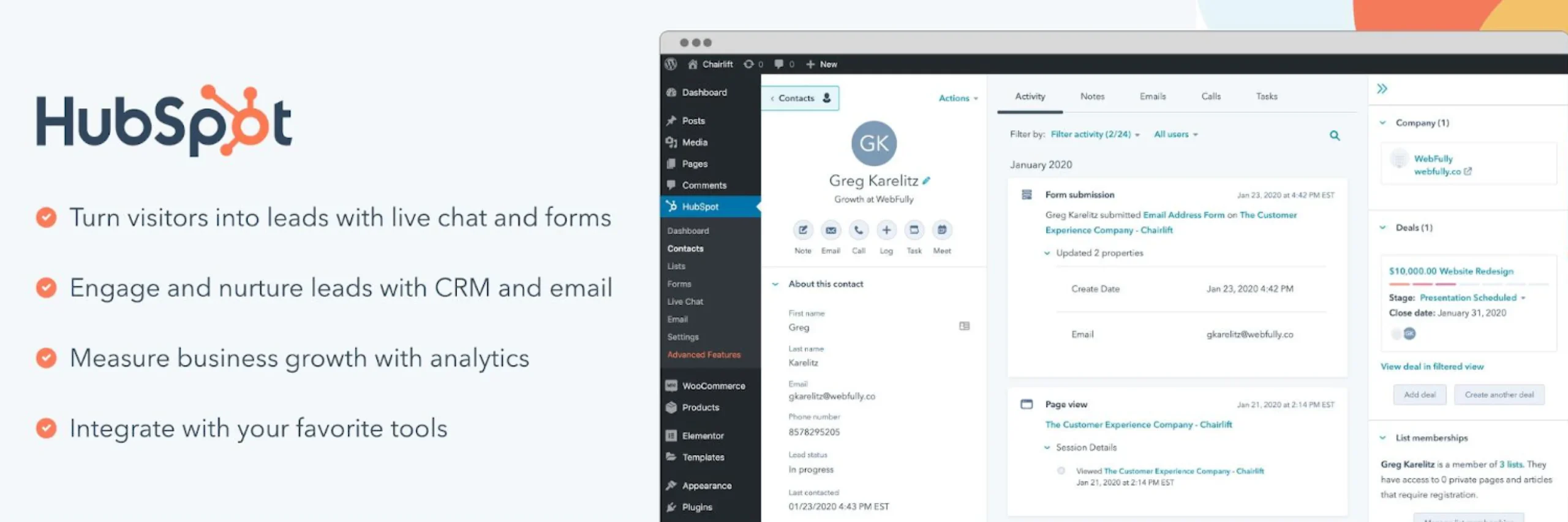
If your business already runs on HubSpot’s CRM, the free live chat tool is a genuinely useful starting point — conversations sync directly with existing contact records, so an agent can see a visitor’s history without switching tools.
The catch is that HubSpot’s live chat is really an extension of the broader Marketing/Sales/Service Hub ecosystem, so its standalone value drops significantly if you’re not already using HubSpot for anything else. Paid tiers are priced per seat within Service Hub rather than as a standalone chat product.
Pricing: Free tier available · Paid tiers priced per seat within HubSpot Service Hub plans.
Best for: small businesses already using HubSpot’s CRM who want chat that’s natively connected to existing contact and deal records, rather than a separate best-in-class chat tool.
7. Olark — Best for Simple Human-Led Chat
Olark deliberately stays focused: it’s a straightforward, human-operated live chat tool without the chatbot-automation ambitions of Tidio or Intercom. For a small business that just wants a reliable widget and a real person answering it — no bot flows, no AI resolution layer to configure — that simplicity is the appeal.
Pricing is flat per-agent, which keeps the math simple, though it can add up for a growing team faster than Crisp’s or YS Desk’s structures.
Pricing: Per-agent flat pricing (contact vendor for exact current rates).
Best for: small businesses that want dedicated human live chat without any automation layer to set up or manage.
Pricing Comparison Table
| Platform | Free Plan | Entry Paid Plan | Pricing Model | 5-Person Team (approx.) |
|---|---|---|---|---|
| YS Desk | Yes (1 seat, 100 conv/mo) | $12/mo (3 seats) | Seat + conversation-based | ~$39/mo (Growth, 10 seats) |
| Tidio | Yes (10 seats, 50 conv/mo) | ~$29/mo (100 conv/mo) | Per-conversation | ~$59–749/mo |
| Crisp | Limited | $25/mo (4 seats) | Flat-rate per workspace | ~$95/mo (Unlimited) |
| LiveChat | No | $25/agent/mo | Per-agent | ~$295–445/mo |
| Intercom | No | ~$29–39/seat/mo | Per-seat + AI usage | $195–390+/mo |
| HubSpot | Yes | Varies (Service Hub) | Per-seat | Varies by Hub tier |
| Olark | No | Per-agent | Per-agent | Varies |
Pricing reflects published rates as of 2026 and may change — always confirm current pricing directly with each vendor before purchasing.
Feature Comparison Table
| Feature | YS Desk | Tidio | Crisp | LiveChat | Intercom |
|---|---|---|---|---|---|
| Real free plan | Yes | Yes | Limited | No | No |
| Real-time (WebSocket) messaging | Yes | Yes | Yes | Yes | Yes |
| Live visitor monitoring | Yes | Limited | Limited | Yes | Yes |
| Canned responses | Yes | Yes | Yes | Yes | Yes |
| CSAT surveys | Yes (from Starter) | Yes | Yes | Yes | Yes |
| Internal notes / team collaboration | Yes | Limited | Yes | Yes | Yes |
| AI chatbot in base price | Roadmap | No (Add-on) | Limited | No | No (Add-on) |
| Widget customization depth | High | Medium | Medium | Medium | High |
| Flat-rate pricing option | No | No | Yes | No | No |
How to Choose the Right Live Chat Software for Your Business
Start with your team size and how it’s likely to change. A solo operator or two-person team should weigh flat-rate and free-tier options heavily — YS Desk’s free plan or Crisp’s Pro tier both make sense here. A team of five or more should run the actual math on per-seat pricing before committing, since the gap between a flat-rate platform and a per-agent one widens fast.
Be honest about whether you need chatbot automation on day one. If your main goal is simply answering visitors in real time, a heavy AI-automation platform like Intercom or Tidio’s higher tiers may be more complexity — and cost — than you actually need yet.
Check what’s gated behind higher tiers. CSAT surveys, internal notes, and visitor monitoring are core small-business features that some platforms reserve for mid-tier or higher plans. Confirm what’s actually included at the price point you’re planning to pay, not just what’s shown on the marketing page.
Think about where your customers actually are. If most of your support happens over email or social channels rather than your website, a pure live-chat tool may be the wrong category entirely — look for something with broader channel coverage, like Crisp.
Don’t over-index on the free plan alone. A free tier is great for testing a platform, but check the paid pricing before you build your workflow around a tool you’ll need to pay for in three months.
Hidden Costs to Watch For
A few things worth checking before you commit to any platform on this list:
- AI chatbot add-ons. Several platforms — Tidio’s Lyro, Intercom’s Fin AI — price automation separately from the base plan, sometimes adding 50% or more to the real monthly bill.
- Conversation overage charges. Per-conversation pricing (Tidio) can spike unpredictably during a busy sales period or seasonal campaign, since exceeding your tier’s cap often triggers an automatic upgrade rather than a simple overage fee.
- Branding removal fees. Some platforms charge extra to remove “Powered by [Platform]” branding from the widget — worth checking if a professional, unbranded appearance matters to you.
- Seat caps on self-serve plans. A few platforms cap total seats even on paid self-serve tiers, forcing a jump to an enterprise/custom-quote plan once your team crosses a certain size.
Frequently Asked Questions
YS Desk is the best overall choice for most small businesses in 2026, combining a real free plan, live visitor monitoring, and predictable seat-based pricing starting at $12/month. Tidio is the strongest option specifically if chatbot automation is your priority, and Crisp offers the best flat-rate pricing for teams of three or more.
Entry-level pricing in 2026 ranges from free (YS Desk, Tidio, Crisp all offer usable free tiers) to roughly $25–95/month for a small team on a paid plan. Costs scale differently depending on the pricing model — per-agent platforms like LiveChat and Intercom get expensive faster as a team grows than flat-rate or seat-tiered options like Crisp or YS Desk.
Often, yes — for very early-stage businesses or solo operators. YS Desk’s free plan includes one seat and 100 conversations a month with real-time messaging and visitor tools, which is enough for many small businesses to properly evaluate live chat before paying anything. The main limitation on most free tiers is conversation volume and seat count, not core functionality.
For most small businesses, a well-staffed human live chat tool answers this better than an AI layer does, at least initially. Chatbot automation earns its cost once you’re fielding a high volume of repetitive questions — if that’s not yet your situation, a simpler platform without a separate AI add-on (like YS Desk or Crisp) avoids paying for capability you’re not using yet.
Per-agent pricing (LiveChat, Intercom) charges a fee for every team member with chat access, so cost rises directly with headcount. Flat-rate or workspace pricing (Crisp) charges one fee regardless of how many agents use it, up to a cap. Seat-tiered pricing (YS Desk) sits in between — a set number of seats bundled into each plan tier, so cost rises in steps rather than per person.
Yes. Independent research has found visitors who engage with live chat convert at meaningfully higher rates than those who don’t, and businesses that implement live chat commonly report double-digit increases in website conversion rate. The effect is strongest when chat is staffed and responsive — an unanswered or slow-to-respond widget can hurt the experience rather than help it.