
Introduction
Every support team eventually runs into the same question: should a customer message go through live chat or email? The honest answer is that it depends on what the customer actually needs in that moment, not which channel your team happens to prefer managing.
A shopper trying to decide whether a product comes in their size wants an answer in the next thirty seconds, not tomorrow morning. Someone reporting a billing discrepancy that needs screenshots and a few days of back and forth is usually better served by email, where nothing gets lost between messages. Treating every support conversation the same way, regardless of channel, tends to frustrate customers on both ends of that spectrum.
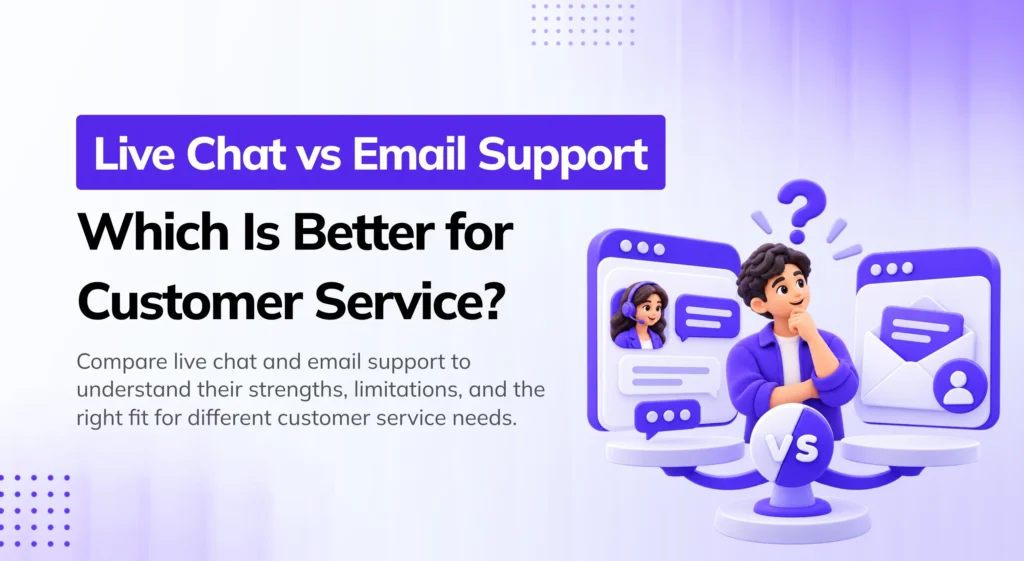
This guide compares live chat and email support directly, where each one genuinely outperforms the other, and how most businesses end up combining both rather than picking a single winner.
What Is Live Chat Support?
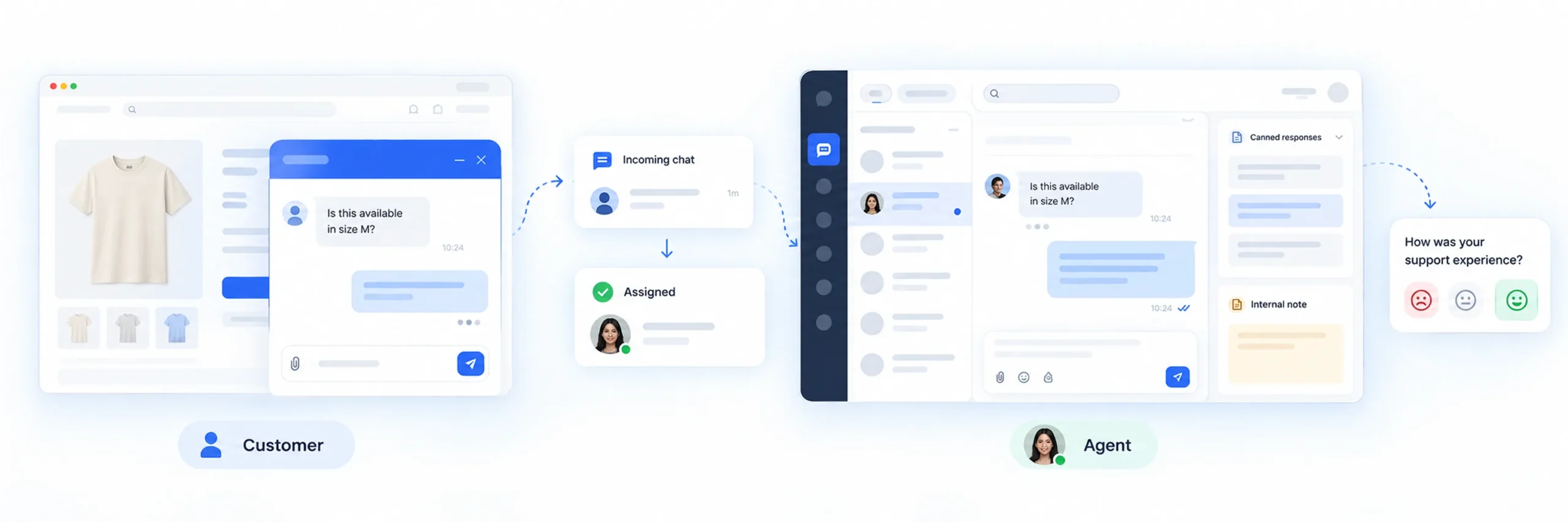
Quick answer: Live chat support is a real time messaging channel, usually embedded directly on a website, that lets customers get an immediate response from a support agent without leaving the page they’re on.
Instead of sending a message and waiting for a reply hours or days later, a customer types a question into a chat widget and, ideally, gets a response within moments. Modern live chat tools go well beyond basic back and forth text, supporting file attachments, canned responses for common questions, internal notes agents can use to coordinate without the customer seeing them, and automatic routing so a conversation lands with the right available agent rather than sitting in a shared inbox.
A tool like YS Desk illustrates what a modern live chat setup typically includes: a chat widget, conversation assignment among team members, canned responses for frequently asked questions, and post-chat satisfaction ratings, all built specifically around handling conversations as they happen rather than after the fact.
What Is Email Support?
Quick answer: Email support is an asynchronous channel where a customer sends a message and receives a reply on a delayed timeline, ranging from minutes to a day or more depending on the business, without needing both parties present at the same time.
That asynchronous nature is really the defining trait. A customer doesn’t need to sit and wait for a reply, and a support agent doesn’t need to drop everything the moment a message arrives. This makes email naturally suited to issues that take time to investigate properly, a refund that needs to be verified against an order record, a technical problem that needs screenshots and a few rounds of troubleshooting, or a request that simply isn’t urgent enough to justify interrupting either side’s day.
Live Chat vs Email: Response Time

This is where the two channels diverge most sharply. Live chat is built around immediacy. A customer expects a reply within a minute or two, and most live chat tools are designed around that expectation, with features like typing indicators and automatic routing that keep a conversation moving without long gaps.
Email operates on a completely different timeline. Even a well run support team typically replies within a few hours rather than instantly, and customers generally accept that delay because they chose an asynchronous channel in the first place. The mismatch happens when a customer expects live chat speed from an email inquiry, or when a business tries to treat live chat as if it can wait like email, leaving a chat widget open with no one actually monitoring it.
| Comparison Factor | Live Chat Support | Email Support |
|---|---|---|
| Average Response Time | Under 2 minutes (immediate) | 1 to 24 hours (asynchronous) |
| Customer Expectation | Real-time conversation on-page | Detailed, structured response |
| Best For | Pre-sale questions, urgent checkouts | Complex audits, technical bugs, formal notices |
| Agent Multitasking | Can handle 3–5 chats concurrently | Queued in batches by priority |
| Documentation / Records | Chat transcripts via email or dashboard | Permanent, searchable email thread |
| Staffing Requirement | Dedicated desk coverage during active hours | Flexible coverage; no live presence needed |
Live Chat vs Email: Customer Experience

Speed isn’t the only factor that shapes how a customer feels about a support interaction, but it’s a significant one. A customer with a quick question—does this ship internationally, is this back in stock—tends to feel genuinely well served by a fast live chat reply, since the alternative of waiting hours for an email answer to a question that simple feels disproportionate.
Email tends to shine in situations where the customer actually benefits from a slower pace. A detailed, well thought out response to a complicated issue often reads better than a rushed, in-the-moment chat reply typed under the pressure of keeping a live conversation moving. Email also leaves a clear written record that’s easy for the customer to reference later, forward to someone else, or search back through months afterward, something a chat transcript technically can but rarely gets treated the same way.
Neither channel is objectively better here. It comes down to matching the pace of the response to what the specific question actually needs.
Live Chat vs Email: Cost and Team Efficiency
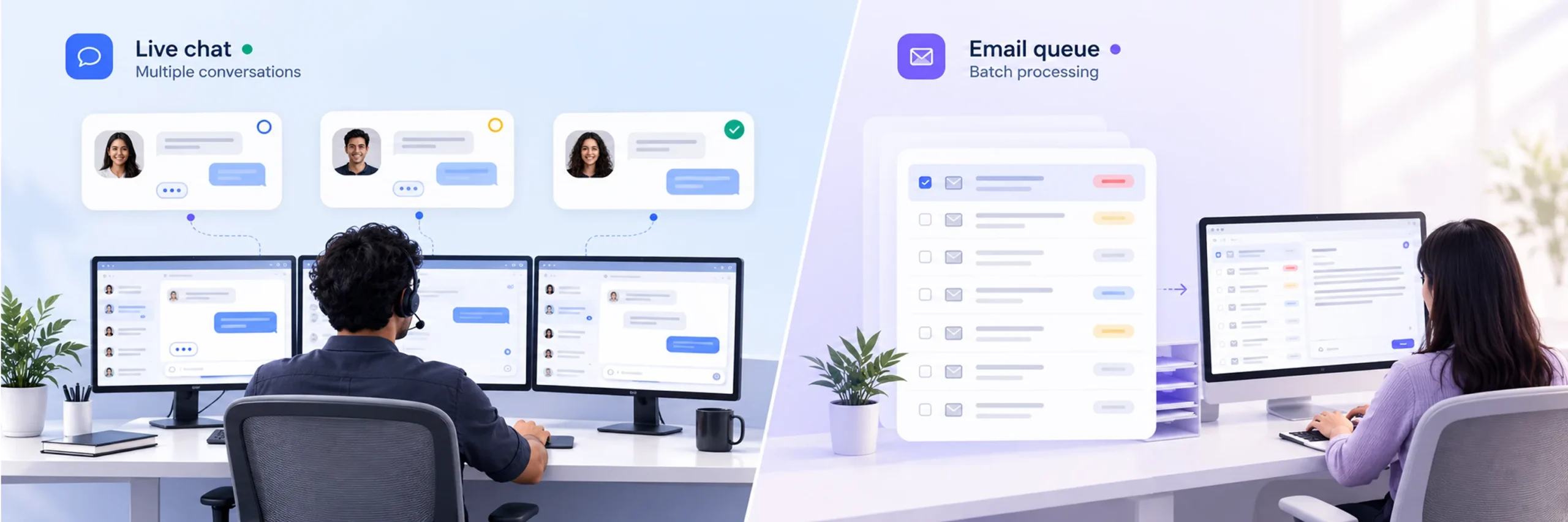
Live chat tends to be more resource efficient per conversation in one specific way: a single agent can often handle several chat conversations simultaneously, since there’s natural downtime while a customer is typing or thinking, unlike a phone call that demands full attention for its entire duration. That efficiency is part of why live chat has become a popular first line of support for many businesses.
Email, on the other hand, doesn’t require real time staffing at all. A support team can process a queue of emails in batches, prioritizing based on urgency, without needing someone actively monitoring inboxes every minute of business hours. This makes email considerably easier to staff for a small team or a business that doesn’t have the volume to justify dedicated live chat coverage throughout the day.
The efficiency calculation ultimately depends on volume and team size. A high-traffic ecommerce site with steady chat volume can make full use of an agent’s capacity to run multiple conversations at once. A smaller business with sporadic support requests may find that same live chat coverage sits idle more often than it’s actually used, making email a more practical starting point.
Live Chat vs Email: Scalability
As a support team grows, both channels scale, but in different ways. Live chat scales through smart routing and automation, unassigned conversation queues, canned responses for repeated questions, and reporting that shows which agents are handling the most volume, all of which matter more as the number of simultaneous conversations increases.
Email scales primarily through organization: shared inboxes, tagging, and prioritization rules that keep a growing volume of messages from turning into chaos. Without that structure, a growing email queue can quietly bury urgent requests underneath routine ones, since nothing about the format inherently signals urgency the way a customer actively waiting in a chat window does.
When Email Still Wins

Despite live chat’s advantages in speed, several situations still clearly favor email:
- Complex issues that need investigation. A billing dispute, a technical bug report, or anything requiring someone to check records before responding accurately benefits from the time email naturally allows.
- Requests involving attachments or documentation. Sending a formal document, an invoice, or several screenshots tends to work more cleanly through email than through a chat window’s file sharing.
- Non-urgent requests outside business hours. A customer emailing at midnight doesn’t expect an instant reply, and email handles that expectation gap naturally, whereas an unanswered live chat message left open overnight can read as the business being unresponsive.
- Situations requiring a formal record. Cancellations, refund confirmations, or anything with potential legal or compliance weight benefit from the clear, easily referenced paper trail email provides.
When Live Chat Wins
Live chat pulls ahead clearly in a different set of situations:
- Pre-purchase questions. A shopper deciding whether to buy right now, rather than abandoning the page to email a question and forgetting to come back, is exactly the moment live chat is built for.
- Quick, factual questions. Shipping times, stock availability, and simple account questions rarely need the deliberation email naturally introduces.
- Reducing cart abandonment. A shopper hesitating at checkout who can get an instant answer to a concern is far more likely to complete the purchase than one who has to wait for an email reply that may not arrive until after they’ve already left.
- Building a sense of active support. A visible, responsive chat widget signals that a real business with real people stands behind the site, which matters more for building initial trust than an email address tucked into a footer ever does.
Can You Use Both Together?
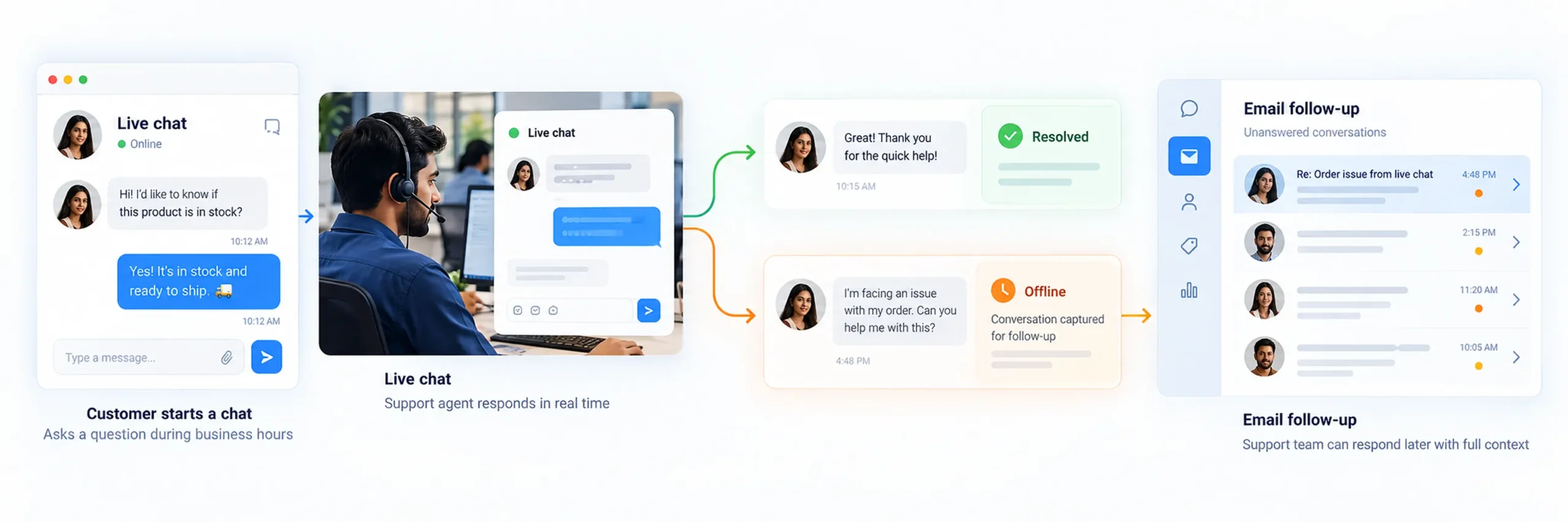
Quick answer: Yes, and for most growing businesses, using both is more effective than committing to just one. Live chat handles the immediate, simple questions well, while email absorbs the complex or non-urgent ones that don’t need real time attention.
A practical setup often looks like live chat available during business hours for quick questions and pre-sale inquiries, with an offline message option that captures the question as an email when no one’s available to answer immediately. That combination avoids the two most common failure modes: a chat widget that goes unanswered outside business hours, and an email-only setup that loses impatient visitors who wanted an answer right now.
Tools built around this kind of setup, YS Desk among them, generally support exactly that hybrid model, offering live chat during active hours alongside automatic offline messaging and email notifications, so a question asked outside business hours still reaches the right person rather than disappearing into an unattended widget.
Frequently Asked Questions
It depends on the type of question. Live chat is generally better for quick, time-sensitive questions and pre-purchase inquiries, while email tends to work better for complex issues that require investigation, documentation, or a formal written record.
Preference tends to depend on the situation rather than a fixed channel loyalty. Customers generally prefer live chat for quick questions where waiting feels unnecessary, and prefer email for anything detailed enough that they’d rather explain in writing and not feel rushed.
Not necessarily. Live chat can actually be more efficient per conversation, since a single agent can often manage several simultaneous chats. The bigger cost factor is staffing live chat during business hours consistently, which matters less for email since it can be handled in batches rather than requiring real time coverage.
Yes, particularly with tools that combine both into one system. Many live chat platforms, including YS Desk, support offline messaging that automatically converts an unanswered chat into an email style follow-up, which lets a small team offer live chat during working hours without needing round the clock coverage.
It can, particularly for ecommerce sites where hesitant shoppers have a quick question standing between them and completing a purchase. Being able to answer that question instantly, rather than losing the visitor to an email inquiry they may never follow up on, tends to recover some purchases that would otherwise be abandoned.
Both can score well on customer satisfaction when used for the right kind of question. Live chat tends to score higher on speed and immediate helpfulness, while email tends to score higher on thoroughness and clarity for complex issues, since agents can take the time to research before responding.
It generally depends on traffic volume and team size. A business with steady website traffic and quick, common questions often benefits from live chat early on, while a smaller business with lower volume may find email sufficient until support volume grows enough to justify live chat coverage.
Final Thoughts
Live chat and email aren’t really competing for the same job. One is built for speed and immediate reassurance, the other for depth and a clear written record. Trying to force every kind of support request through a single channel usually means shortchanging the requests that don’t fit that channel’s strengths.
The more practical approach, and the one most growing businesses eventually land on, is offering both and letting the nature of the question guide which one gets used. A live chat tool that also captures offline messages as email, the way YS Desk and similar platforms are built to do, gives a support team the immediacy of chat during active hours without leaving customers stranded the moment everyone logs off for the day.