
Introduction
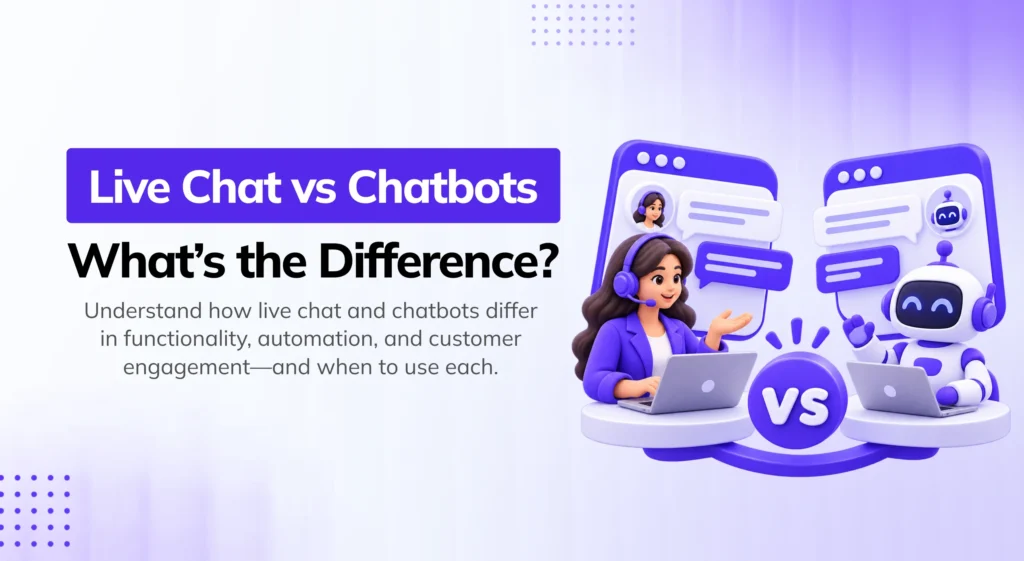
The terms live chat and chatbot get used almost interchangeably in casual conversation, which causes more confusion than it should. Both show up as a small chat window in the corner of a website. Both let a visitor type a question and get a reply without picking up the phone or sending an email. But what happens behind that chat window is fundamentally different, and mixing the two up leads to real mistakes, like assuming a chatbot can handle a sensitive billing dispute, or staffing live chat around the clock when an automated tool could have covered the overnight hours just fine.
The distinction matters more now than it did a few years ago, since chatbots have gotten noticeably better at sounding natural and handling a wider range of questions, which blurs the line further for anyone comparing the two from the outside. Understanding what each one is actually built for, rather than just what they look like on the surface, makes it much easier to decide where to use one, the other, or both.
This guide breaks down what live chat and chatbots actually are, where each one clearly outperforms the other, and how they typically work together on a well run support setup.
What Is Live Chat?
Quick answer: Live chat is a real time messaging channel where a customer’s message goes directly to a human support agent, who reads it and responds personally, the same way a text conversation works between two people.
There’s no automation deciding what to say back. An agent reads the actual question, considers the specific situation, and writes a response tailored to it. Modern live chat tools add structure around that human conversation, canned responses for repeated questions, internal notes so a colleague can be looped in, and routing so a message lands with an available agent rather than sitting in a shared inbox nobody’s watching. A platform like YS Desk, for example, is built specifically around this kind of human-driven conversation: assigning chats to agents, tracking conversation history, and giving a team visibility into who’s handling what.
What Is a Chatbot?
Quick answer: A chatbot is software that automatically replies to a customer’s message without a human writing that specific response in real time, using either a set of pre-programmed rules or, in more advanced versions, AI trained to generate a more flexible, natural sounding reply.
The simplest chatbots follow a decision tree: a customer picks from a menu of likely questions, or types something that matches a known keyword, and the bot returns a pre-written answer. More advanced, AI-driven chatbots go further, trained on a knowledge base, help documentation, or past conversations, letting them respond to a wider range of phrasing rather than requiring an exact keyword match. Either way, the defining trait is the same: no person is actively composing that individual reply as it’s sent.
The Core Difference: Human vs Automated
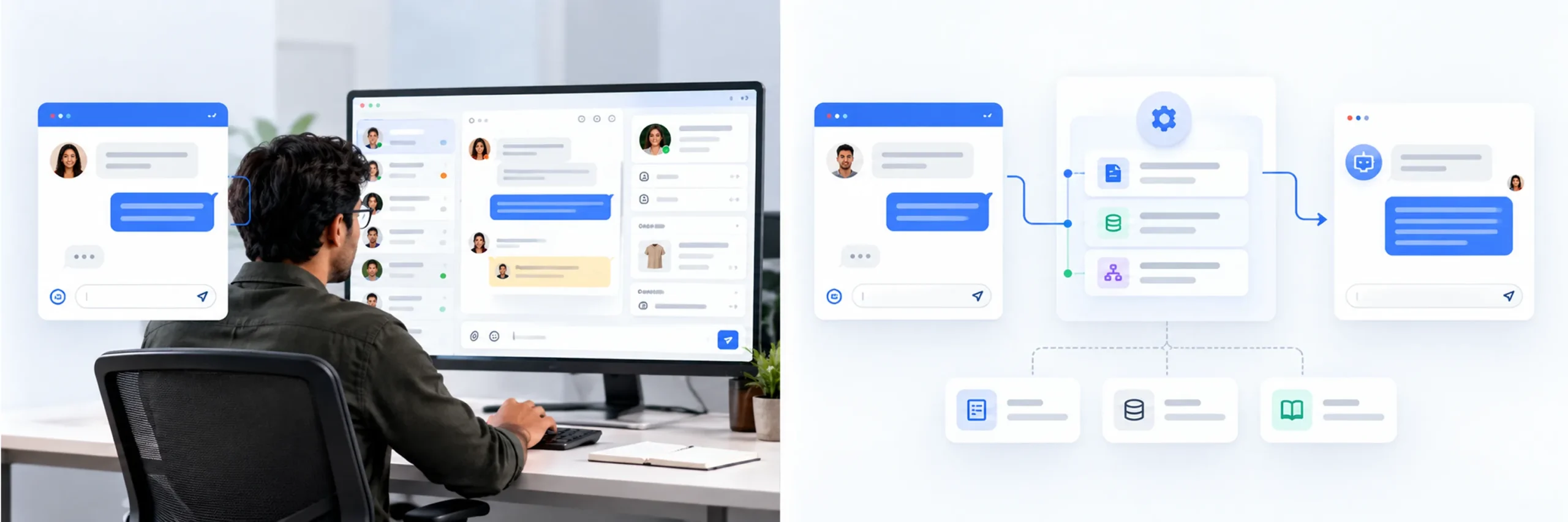
Every other difference between live chat and chatbots stems from this one distinction. Live chat is powered by a person thinking through a specific situation. A chatbot is powered by logic or a trained model responding based on patterns, not genuine understanding of the individual customer’s particular circumstances.
That single difference explains why chatbots excel at consistency and speed for predictable questions, while live chat excels at judgment and nuance for questions that don’t fit a predictable pattern. Neither trait makes one option universally better. They’re suited to different kinds of conversations.
| Comparison Dimension | Live Chat | Chatbots |
|---|---|---|
| Primary Operator | Real human support agent | Automated script or AI model |
| Best Used For | Complex issues, complaints, VIP sales | Repetitive FAQs, basic order lookup |
| Availability | Dependent on staff working hours | True 24/7 continuous uptime |
| Personalization & Tone | High empathy, context-aware nuance | Consistent, pattern-based responses |
| Cost to Scale | Scales with agent headcount & shifts | Low marginal cost per conversation |
| Handling Exceptions | Adapts fluidly in real time | Requires escalation fallback to human |
Live Chat vs Chatbots: Availability

A chatbot can run continuously without needing anyone present, which makes genuine 24/7 coverage straightforward in a way that live chat generally isn’t. Keeping live chat staffed around the clock means covering night shifts and weekends with real people, which is a meaningful cost and scheduling commitment most smaller businesses simply can’t justify.
That said, availability isn’t the same as usefulness. A chatbot being available at three in the morning is only valuable if it can actually help with what a customer needs at that hour. For a simple question, checking an order status or finding a return policy, that’s genuinely useful. For a complicated account issue, being available but unable to help isn’t much better than not being available at all.
Live Chat vs Chatbots: Personalization

A human agent can pick up on tone, read between the lines of a frustrated message, and adjust their response accordingly in a way that even a well trained chatbot generally can’t replicate consistently. A customer who’s clearly upset about a shipping delay usually responds better to an empathetic human reply than to an automated one, however polished the automated wording happens to be.
Chatbots have gotten better at simulating personalization, referencing a customer’s order history or previous questions to sound more tailored, but there’s still a meaningful difference between a system generating a response based on patterns and a person genuinely understanding a specific situation. For routine questions, that difference barely matters. For anything emotionally charged or unusual, it tends to matter quite a bit.
Live Chat vs Chatbots: Cost and Staffing
Chatbots typically cost less to scale, since handling a hundred simultaneous conversations doesn’t require a hundred times the resources the way staffing that many live agents would. This makes chatbots attractive for absorbing high volumes of repetitive questions without proportionally growing a support team.
Live chat costs scale more directly with headcount and hours covered, though a single live agent can often handle several conversations at once, which helps offset the cost somewhat compared to something like phone support that demands full attention per call. The realistic cost comparison usually favors chatbots for handling volume and live chat for handling quality on the conversations that actually need it, rather than one being flatly cheaper than the other across every use case.
Live Chat vs Chatbots: Handling Complex Issues
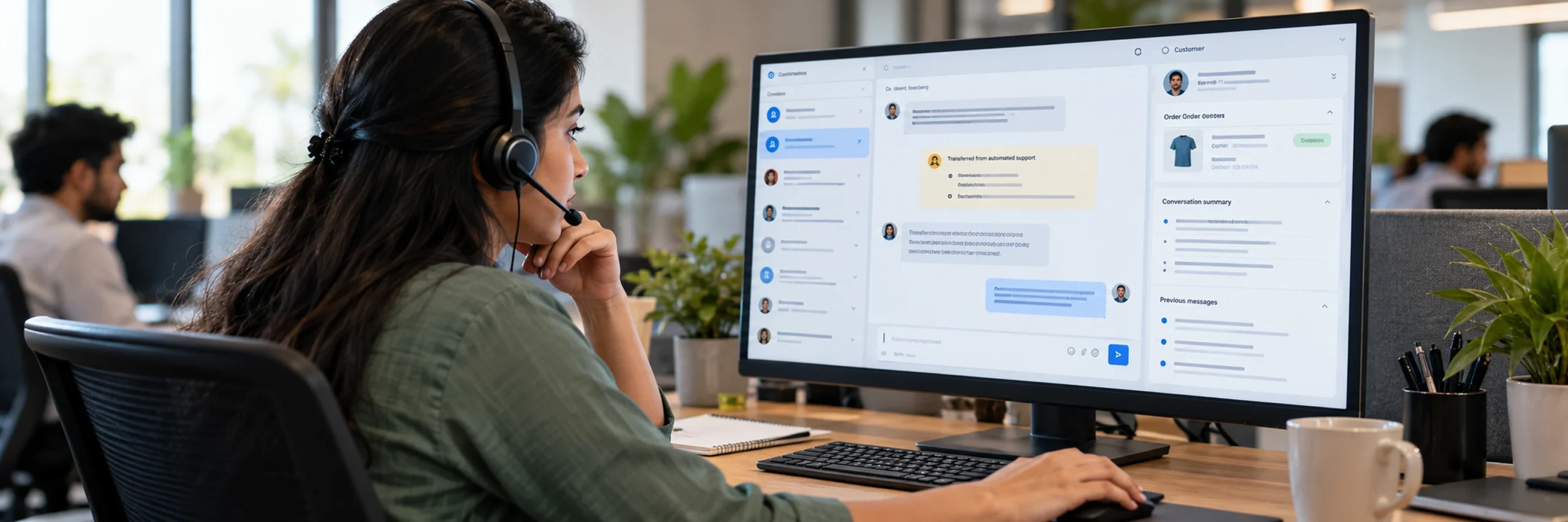
This is where live chat pulls ahead clearly and consistently. A billing dispute that needs someone to actually check account records, a technical problem that requires troubleshooting back and forth, or a complaint that needs a genuine apology and a thoughtful resolution all benefit from a human who can adapt in real time rather than follow a fixed script.
Chatbots can still play a useful role even here, often by gathering initial details, an order number, a brief description of the issue, before handing the conversation to a human agent who then has context already available rather than starting from scratch. That handoff, done well, saves time for everyone without forcing a chatbot to attempt something it isn’t built to handle.
Types of Chatbots You’ll Encounter
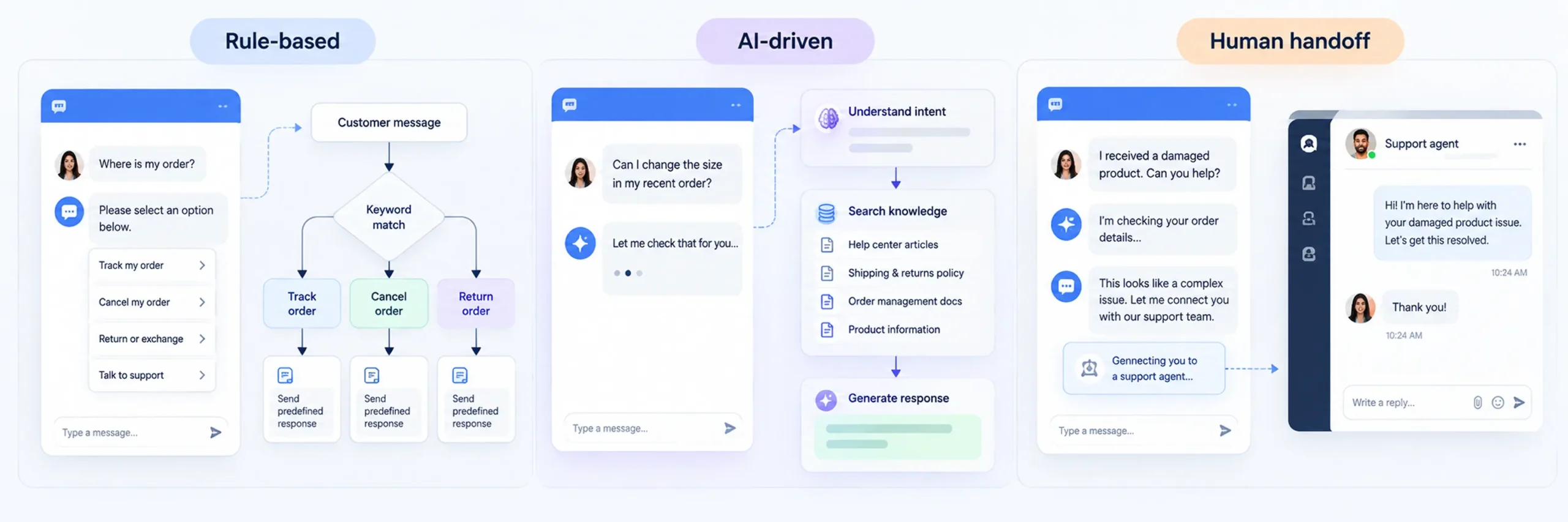
Not all chatbots work the same way, and understanding the differences helps set realistic expectations for what a given bot can actually do:
- Rule-based chatbots follow a fixed decision tree. A customer selects from a menu or types a message that matches a specific keyword, and the bot returns a pre-written response. These are predictable and easy to set up, but they struggle the moment a question falls outside the exact patterns they were built to recognize.
- AI-driven chatbots use a trained model to interpret a wider range of phrasing and generate a more flexible response, often pulling from a knowledge base or help documentation rather than a fixed script. These handle a broader range of questions more gracefully, though they still work within the boundaries of what they’ve been trained on.
- Hybrid setups combine a chatbot for the initial response with a clear path to a human agent when the bot can’t resolve something or when the customer specifically asks for a person. This tends to be the most practical setup for most businesses, since it captures the efficiency of automation without trapping a frustrated customer in a loop with no way out.
When a Chatbot Makes More Sense
A chatbot tends to be the better fit for highly repetitive, predictable questions: order status, business hours, shipping policies, account setup steps. These are questions with a single correct answer that rarely changes, which is exactly the kind of task automation handles well without losing anything in translation.
It also makes sense for overnight and after-hours coverage, where the alternative is no response at all rather than a slower human one. And it’s a reasonable first line of defense for a high-traffic site where the volume of simple questions would otherwise overwhelm a small support team.
When Live Chat Makes More Sense
Live chat is the better fit whenever a question requires judgment, empathy, or flexibility a script can’t provide. A customer deciding whether to make a significant purchase often wants reassurance from an actual person, not an automated reply, before committing. A complaint or a sensitive account issue generally needs a human who can adapt the response to the specific situation rather than following a fixed flow.
It’s also the better choice when building trust matters more than raw speed. A genuine, thoughtful human reply, even if it takes a minute longer than an instant automated one, tends to leave a stronger impression on a customer who’s hesitating or upset.
Can You Use Both Together?
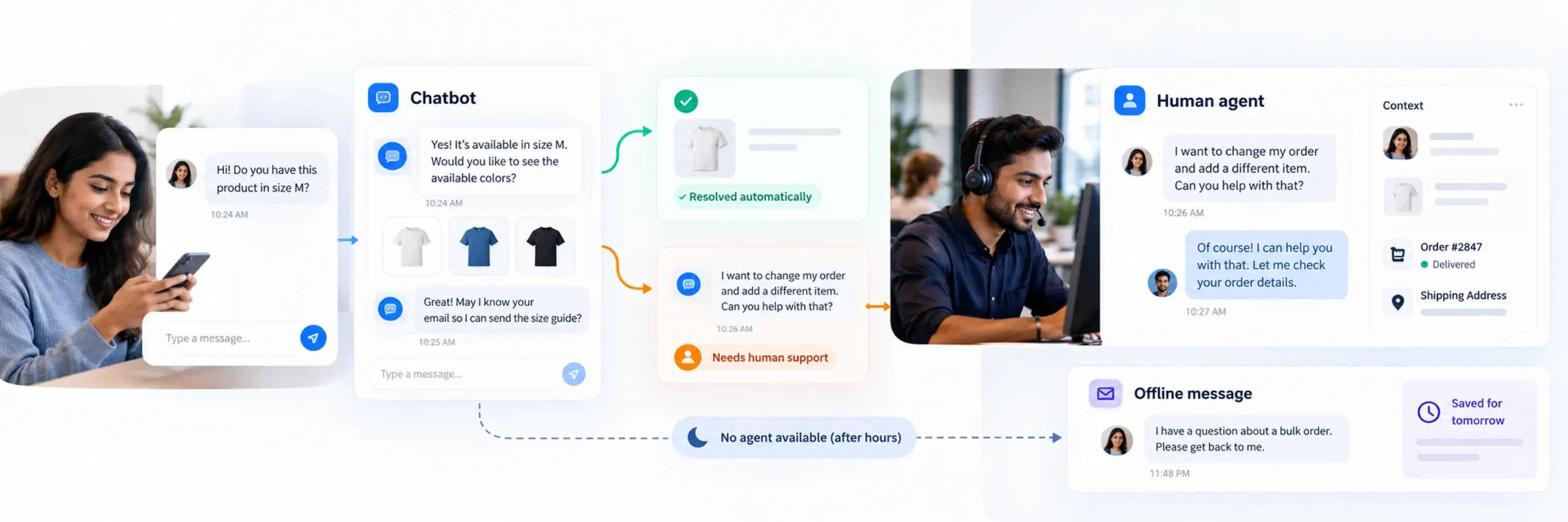
Quick answer: Yes, and for most businesses beyond a very small scale, combining both tends to work better than relying on either one alone. A chatbot handles repetitive questions and initial information gathering, while live chat takes over for anything that needs a real person’s judgment.
A common and effective setup looks like this: a chatbot answers straightforward questions instantly and, when it can’t help, offers a clear path to a human agent rather than leaving the customer stuck. During business hours, that handoff goes to a live agent in real time. Outside business hours, the same conversation can convert into an offline message that reaches the team the next morning rather than disappearing entirely.
This is generally the model tools built around live chat, YS Desk included, are designed to support: real time conversations and assignment during active hours, with offline message handling that catches anything that comes in when no one’s available, so a chatbot layer or a simple after-hours message capture can sit alongside the live conversation flow rather than replacing it.
Frequently Asked Questions
No. Live chat connects a customer directly with a human agent who writes each response personally. A chatbot uses automated rules or AI to generate responses without a person composing that specific reply in real time.
It depends on the type of question. Chatbots are generally better for quick, repetitive, predictable questions and after-hours coverage, while live chat is better for complex, sensitive, or unusual situations that benefit from human judgment.
For most businesses, no. Chatbots handle routine questions well, but they tend to struggle with anything genuinely complex, emotionally charged, or outside their training, which is exactly where a human agent adds the most value.
Generally not. Chatbots tend to cost less to scale since handling more volume doesn’t require proportionally more resources, while live chat costs scale more directly with the number of agents and hours covered.
A rule-based chatbot follows a fixed decision tree and only handles questions matching its predefined patterns. An AI-driven chatbot uses a trained model to interpret a wider range of phrasing and generate more flexible responses, often based on a knowledge base rather than a fixed script.
It depends on volume and available staffing. A small business with modest traffic may find live chat alone sufficient, while one with higher volume or a need for 24/7 coverage often benefits from a chatbot handling routine questions with live chat available for anything more complex.
Generally, a chatbot should hand off when it can’t confidently answer a question, when a customer directly asks for a human, or when the conversation involves something sensitive, like a complaint, a billing dispute, or an account security issue, that benefits from personal judgment.
Final Thoughts
Live chat and chatbots aren’t really competing tools trying to do the same job better than the other. One relies on human judgment and empathy, the other on speed and consistency for predictable questions. Treating them as interchangeable, or assuming one can fully replace the other, tends to create gaps: a chatbot stuck trying to handle a nuanced complaint, or a live agent stretched thin answering the same simple question for the fiftieth time that day.
The more practical approach is letting each one do what it’s actually good at. A chatbot absorbs the repetitive volume and keeps something available around the clock, while live chat steps in for anything that genuinely needs a person’s attention. Tools built around that kind of setup, YS Desk among them, tend to work well precisely because they don’t force a choice between the two. They give a team the structure to run live conversations properly while still leaving room for automation to handle what doesn’t need a human touch.